International Best Practices Are (Sometimes) Bad
American engineers tend to tackle problems differently than Old World engineers do, and that's okay.

I. Amazon Leo and Satellite Internet
Last week, Amazon launched a rocket. Okay, no, Blue Origin, founded by Jeff Bezos, launched a rocket. But Blue Origin is tied to Amazon closely enough that Amazon felt comfortable formally launching their satellite internet service upon the successful launch of Blue Origin’s rocket. Formerly known as Project Kuiper, Amazon Leo is a satellite internet service with the goal of building “fast, reliable internet to those beyond the reach of existing networks.”

This is not a new strategy. It was pioneered by Elon Musk’s SpaceX, which uses their enormous launch cost advantage to launch huge numbers of internet satellites. In turn, that allows Starlink to reach large numbers of customers, across every corner of the world, in places where a broadband internet connection is not even remotely cost-competitive. But “universal fast wifi” is not where the story ends. Starlink is working on an implementation direct-to-cell service in a partnership with T-Mobile, enabling universal 4G LTE coverage literally everywhere you can see the sky. No more coverage gaps, no more dead areas, just internet… everywhere.
You probably do not need speeds any faster than 4G LTE on your phone. LTE provides speeds of 10-20mbps on your phone, while 5G offers a roughly 10x increase in performance. (Although it depends on the standard you’re referring to. It’s complicated.) Phone calls require a tiny fraction of that performance, and even large app downloads shouldn’t take more than a few minutes. The fundamental tradeoff of all cell systems is durability - shorter bandwidths mean faster speeds, but also get disrupted more if you block them. Personally, I’ve found 5G networks so unreliable that my internet-based voice calls were dropping, so I’ve turned 5G off on my personal phone. Direct-to-cell satellite service means that in the future, I will literally never need to interact with terrestrially-based cell phone infrastructure. It’s worth stopping to ponder exactly what that means.
II. Rural Broadband, and 5G
In Biden’s infrastructure bill, $42 billion was allocated to connecting rural communities to the internet through a variety of rural broadband subsidies. Those subsidies have managed to connect precisely zero people in the three years after they passed. But even if they were successful at their goals, it’s worth thinking about how much $42 billion actually is. Blue Origin spent probably $5 billion on New Glenn (numbers for this are scarce), SpaceX spent around $25 billion on Starship, but is recovering some of that cost through moon mission contracts anyways. Starlink itself was estimated to cost about $10 billion dollars, which combines to $40 billion.
For less than the cost of the government rural broadband allocation, you could invent an entirely new, partially-reusable heavy lift rocket, then invent another fully-reusable super-heavy lift rocket, design a satellite capable of beaming LTE everywhere on earth, and then launch tens of thousands of satellites to orbit to build this network. And of course, the government’s strategy didn’t actually connect anyone to the internet. But actually, it gets worse than this.

The world has paid literally a trillion dollars - 25 times the cost of universal global space-based 4G LTE - to build out a 5G network. China committed to spending $600 billion through this year, the US committed to spend $400 billion (per the same source), and Europe thinks buildout will cost around $400 billion. How many more dollars would it cost to build satellites that can deliver universal 5G with a small amount help from ground-based infrastructure in dense urban areas? Maybe another 5% of that?
What I’m trying to get at is that building permanent, fixed infrastructure on earth is expensive. In super-dense areas like China or Western Europe, that’s feasible (although still not exactly ideal). But in the low-density United States, it isn’t. It’s not a coincidence that both of these initiatives are American - the mandate for minimizing marginal costs is fairly unique to the western hemisphere. Europe and China can spend lots of money, everywhere. But America has to create technologies that minimize the cost of deploying high-tech solutions in rural areas, even if that means higher spending on the research to create them. Satellite internet is the most recent memorable example of this phenomenon, but this pattern extends far beyond internet.
Because, after all, this is a blog about transportation.
III. High Speed Rail, vs Interurbans
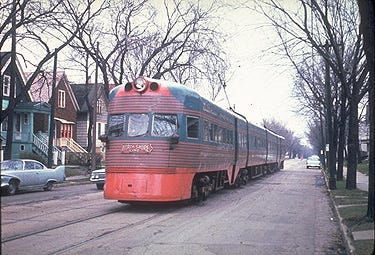
If you looked at the direction of railroad innovation in the 1950s and 1960s, it would have been clear that America was on a very different path from the rest of the world. Europe, China, and Japan had nationalized their railroads in service of both world wars, and had not unprivatized them afterwards like the US did. (The USSR also had nationalized their railroads, for predictably not-world-war related reasons.) Europe and Japan were democracies who pandered to voters by improving passenger trains. That put them on a path to inventing high-speed rail, which requires lots of investment for new dedicated rail lines, often through populated areas.
[Sidenote: The expansiveness of a passenger rail network is highly visible to voters, while the higher costs that imposes on freight rail users are not. Thus, the direction of all nationalized railroads in a democracy is to send high quality, high-speed passenger trains everywhere, while freight trains wither away into nothing. The electoral pressures on a national rail network are why I’m against freight rail nationalization, and why you should be too.]
Meanwhile, America was on a completely different course. Freight is by far more profitable than passengers, so major American railroads were focusing on expanding their freight businesses. One key way of doing that was by lowering costs through modernization. The New York Central was a leader, implementing a new and world-leading computer routing system which tracked all railcars on the network, in 1963. Centralized train control systems and reductions of branch lines concentrated traffic, enabling railroads to carry longer trains on fewer tracks. The 1950s also saw rising amounts of “piggyback” traffic, where trucks were loaded onto trains to obtain the benefits of low railroad costs and high truck reach.

While long distance American passenger railroads were struggling, their shorter haul counterparts - the interurbans - were in even more trouble. Interurbans were developed out of 1900s streetcar technology, but by the 1920s they were their own kind of railroad, best described as the railroad equivalent of a swiss army knife1. They were equipped with sufficiently strong brakes and conical wheels to run as streetcars. But at the same time, they were durable enough to conform to FRA standards on crashworthiness (which were not quite as restrictive as they are now). They were also fast enough to hit speeds as fast or greater than mainline trains. The most famous of these trains was the Electroliner, which through ran onto the Chicago L system and could handle its tight curves but also had a top service speed of 90mph on its way to Milwaukee. The fastest trains on the Pacific Electric, in the LA metro area, also ran at over 70mph.
The other notable attribute of interurbans was that they were cheap. Compared to mainline trains, interurbans were lighter, reducing maintenance requirements for both trains and tracks. They could be operated by one person, significantly reducing labor costs. Their light weight meant they used less energy than mainline electric trains, which themselves were far more efficient than mainline steam power. The industry was militant about maintaining and pressing its cost advantage. Rolling stock from the 1920s reduced maintenance costs by half, and industry publications were filled with cost-saving advice (“using fare tokens lowers operator burden and allows one person train operation on busier lines”, “grinding rails regularly extends their lifespan”). Pressures to reduce energy costs even further led the Brill car company to analyze new train car designs in a wind tunnel for the first time. The resulting bullet cars used 40% less energy at speeds over 60mph.
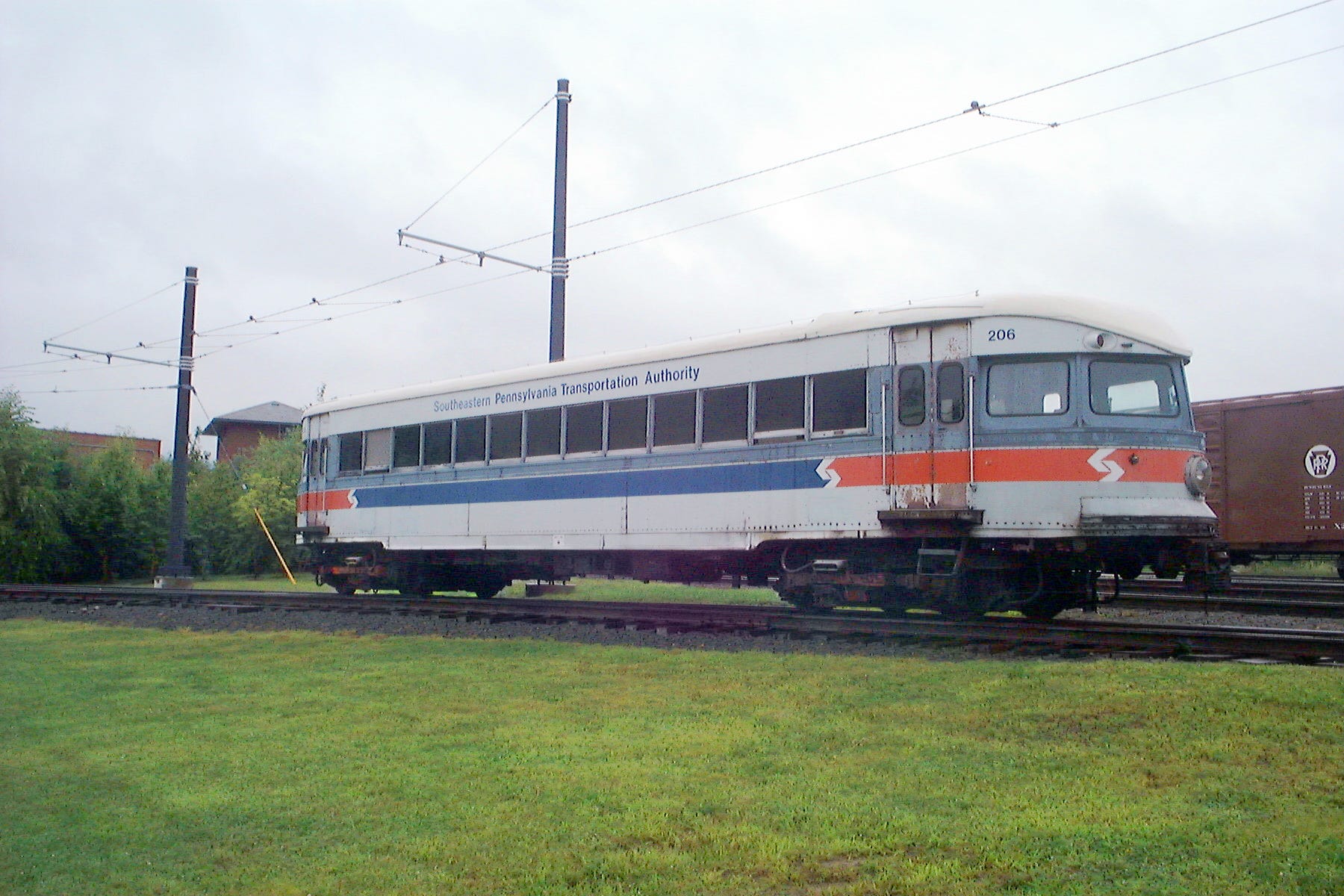
A trend emerges here. Eurasian railroad technologies focused on a push towards exacting standards eventually leading to the high speed train. In many cases, they traded cost efficiency for the benefits of greater comfort and speed. Meanwhile, American railroads pushed in the opposite direction. Trains were designed to minimize maintenance costs, reduce labor burdens, and use minimum possible levels of infrastructure. Innovations in American railroading (computerization, one person train operation) provide almost no progress against European benchmarks, and vice versa. In other words, the cellular internet and railroad industries diverged in Europe and America, almost identically.
IV. Amtrak
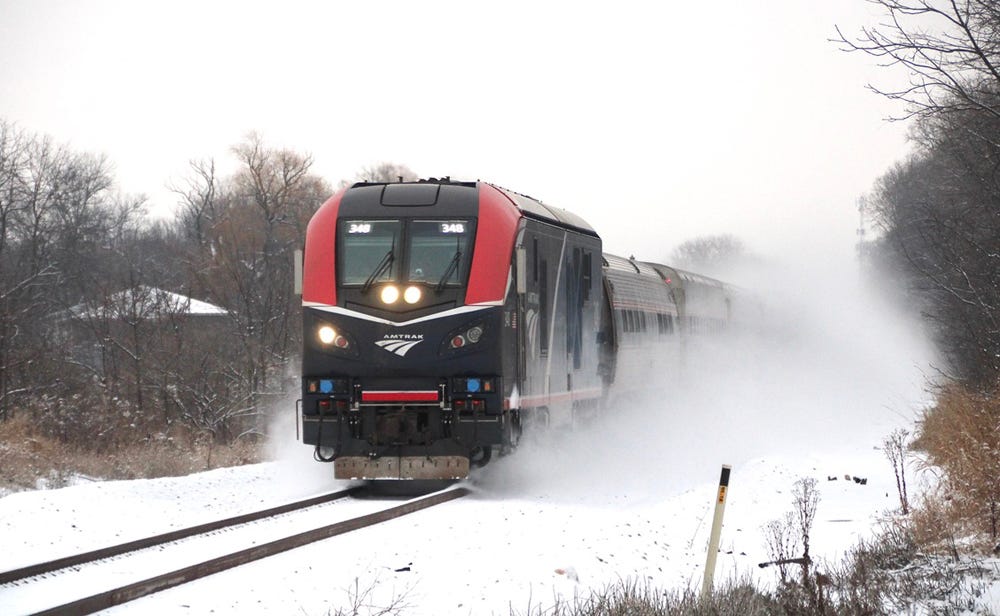
All that raises the question of what exactly we’re getting when we buy trains from Europe. The previous generation of Amtrak’s locomotives was built on the GE Genesis platform, designed in the US. But since then, GE sold their locomotive business to Wabtec, which has very little interest in passenger railroad locomotives. That ceded the market to German manufacturer Siemens, which is also contracted to supply train cars to Amtrak, locomotives to several other short-haul railroads (including Brightline), and also now dominates light rail vehicle contracts. The new long-distance locomotives are named ALC-42s, replacing the earlier P42DCs.
The first ALC-42s entered service in 2022, and their service life so far has not been illustrious. Apparently, Siemens didn’t realize that it snowed in the midwest, and didn’t add proper air filtering mechanisms. Consequently, snow was being sucked into air brake systems and causing failures. That was since fixed, but an official government spokesperson (!) told Railway Age that “the light-dry snow of the mid-west was not anticipated by Siemens”. How embarrassing. But the problems didn’t end there - Amtrak discovered accelerated engine wear on locomotives on the Pacific Surfliner (between LA and San Diego, the best weather environment imaginable) last year. One redditor also anecdotally says they fare worse than the Genesis locomotives when “hitting stuff”, presumably at grade crossings.
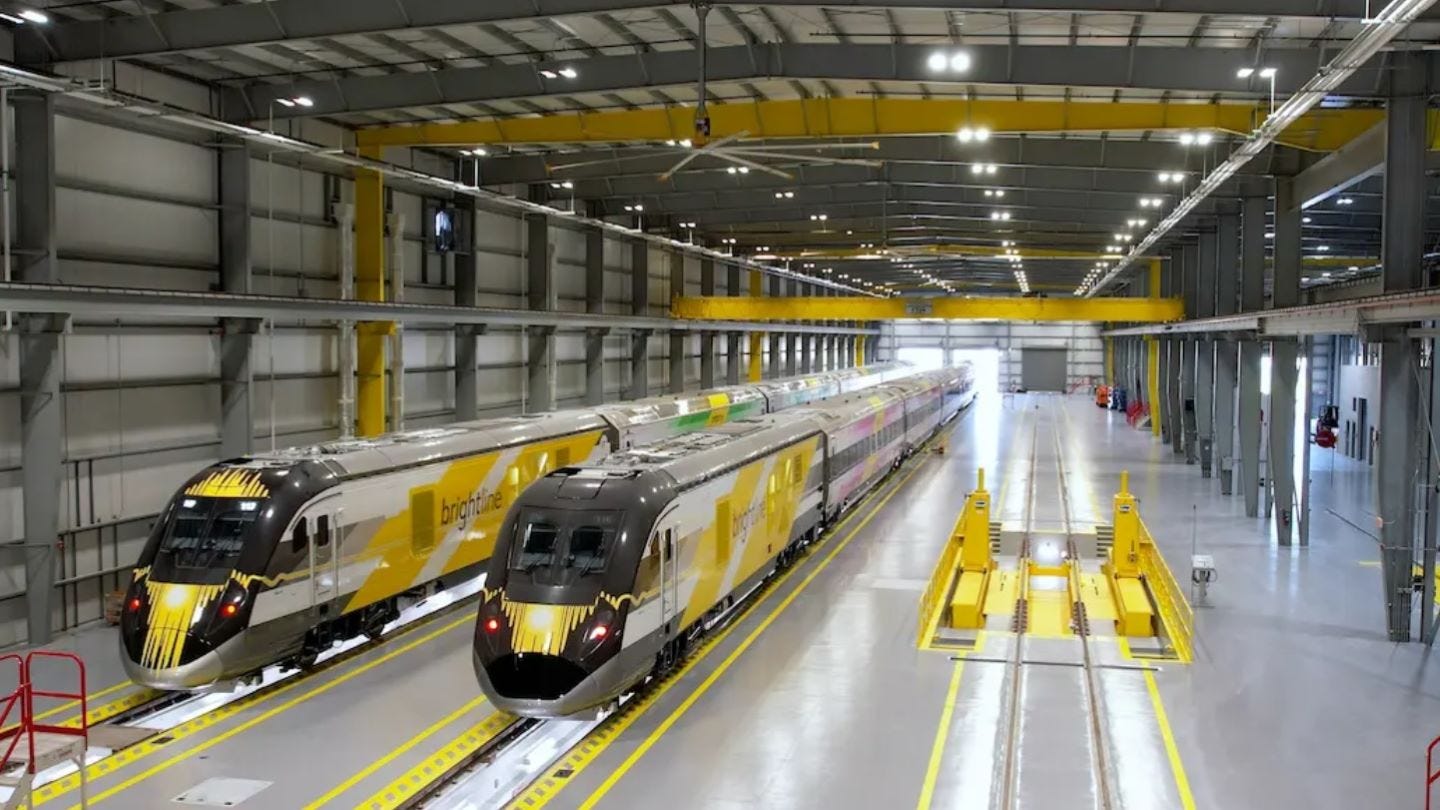
Interestingly, Brightline also bought Chargers for their new railroad operations, but they’ve had no maintenance problems whatsoever. Part of that discrepancy is undoubtedly that Florida is warm and sunny, so the cold-weather failures that Amtrak has simply never come up. But that doesn’t explain the accelerated engine wear on the similar Pacific Surfliner.
I suspect the difference is largely down to maintenance practices. Brightline has a maintenance facility that allows 8 out of 10 trains to undergo maintenance at any given time. It’s also big enough to park all trains indoors. Siemens’ case study on Brightline maintenance practices indicates that most trains see maintenance every night, with maintenance done preventatively in short increments. That ensures Brightline trains almost never break down. Brightline’s constraints (no overnight service, huge maintenance space) match Europe’s service constraints relatively closely. Amtrak, meanwhile, doesn’t.
It is literally impossible for long distance Amtrak trains to see nightly maintenance. Amtrak trips can be up to three days in length, which means a locomotive is continuously in service for several days at a time. But even that understates the level of severity. Amtrak doesn’t have the resources to put maintenance depots at both ends of every once-daily long distance route, nor does it leave them enough layover time to use them if they did exist. An Amtrak train might leave Chicago for Seattle, travel for three and a half days, lay over for a single-digit number of hours, then make the same trip in return and only be available for maintenance on day 7. Both railroads are required to do significant maintenance twice a year. But Amtrak does heavy maintenance at a centralized location in Wilmington, which would require pulling trains off routes for service.2 So I suspect Amtrak trains aren’t seeing any more maintenance than they have to.
I cannot help but think these two things are connected. The Charger was built by putting an American diesel engine into a fundamentally European locomotive architecture. It was designed for frequent, proactive maintenance. It expected high standards from its operators, and was in turn supposed to uphold high service standards on acceleration and top speed. Meanwhile, Amtrak’s needs in America are different. In order to function, Amtrak needs to operate locomotives built like tanks. Locomotives need to be capable of operating all the time, with limited maintenance, in all conditions, all while being parked outside in the elements when not in use.
The fact that Siemens didn’t do very well at accommodating Amtrak’s demands isn’t entirely their fault. They’re a European locomotive manufacturer, which is accustomed to building locomotives for Europeans, and it isn’t in their operational DNA to accomodate the sort of abuse that American railroads demand. (Alstom, tasked with building the next-gen Acela, had a similar failure mode when they couldn’t figure out how to model the Northeast Corridor in a computer.) It’s not really Amtrak’s fault for selecting Siemens - GE/Wabtec weren’t interested in bidding for the ALC-42 contract. But it is true that American freight railroads order thousands of totally-functioning long distance locomotives and don’t have any problems. It’s true that passenger and freight locomotives are somewhat different. (Passenger locomotives are geared to go faster, pull lighter loads, and need to power passenger cars in a way freight trains don’t.)
But maybe they could have at least tried the solution that works already?
V. Policy In General
I put all of these data points in one post on purpose. America adopts Eurasian standards and expectations very easily. Especially in fields where America doesn’t lead, we have a very strong tendency to blindly follow, without considering the circumstances that created those standards. American policymaking should do that less. We should strive to find solutions that can benefit everyone when deployed centrally, like cheaper rocket launches, lower-impact railcars, or more durable locomotives. We do not have to be like Eurasia all the time. As I’ve said before, American trains are pretty good, and the ways in which they could be better don’t line up to the ways they’re good abroad. Where good public policy suggests trying modified freight locomotives, Eurasian standard adoption suggests doing California High Speed rail.
Standard choice is important, because it really is tempting to adopt high Eurasian standards that require large amounts of infrastructure deployment. They make for strong resume material, they’re “international best practices” which are easy for advocates to point to, and they’re likely to work if furnished with enough money. But that doesn’t make them good uses of resources. American policymakers should get more comfortable coming up with their own, cost-first solutions, and leading analysis with cost/benefit numbers rather than gross toplines. We should think critically about what makes the international best practices so good abroad, and whether those factors exist in the US - they often do not.
Most of this section is written using the now-dimming memories of my read of The Interurban Era, a book cataloging this very odd type of railroad. And you can read it too, it’s completely free on Internet Archive!
https://archive.org/details/interurbanera00midd/page/12/mode/2up
Regarding modifying US freight locomotive designs for passenger use - didn't Amtrak do that in their early days, and see less than stellar results across multiple models? Might be one reason they were so reluctant to take that path again.
It’s worth noting that you can make the argument that European standard adoption actually suggests non-HSR improvements as well. https://open.substack.com/pub/marcochitti/p/the-long-modernization-of-the-italian?r=4g34gq&utm_medium=ios
But of course HSR will have a lot of appeal no matter what sensible experts will tell you.